At the Potter Museum, “65,000 Years: A Short History of Australian Art”; an exhibition that provokes, challenges, and reinvents.
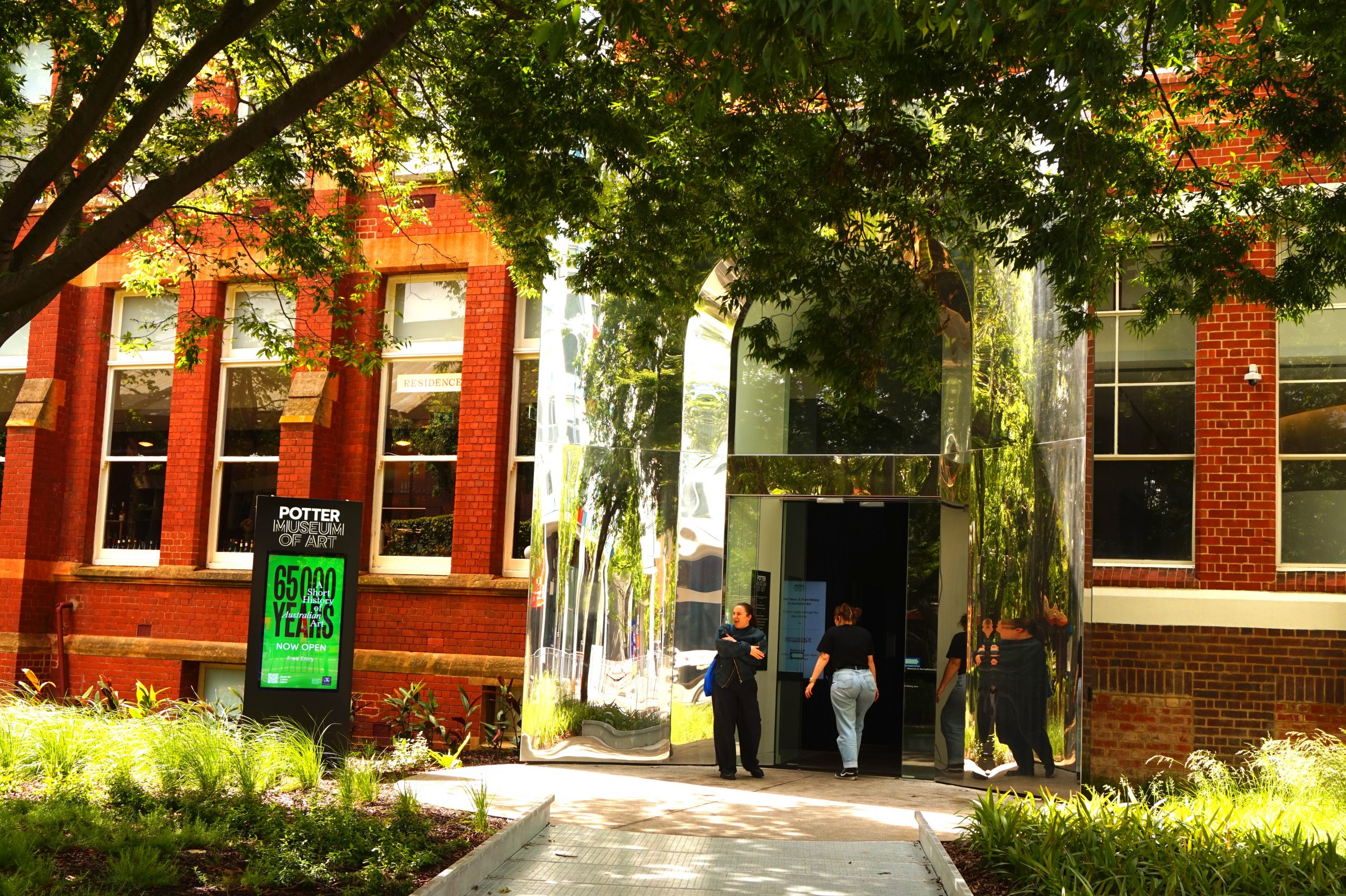
Passing through the polished steel gate designed by Randal Marsh, visitors enter a suspended space where time stands still. In just a few steps, they find themselves in some sort of contemporary antiquity, a territory where the story of Aboriginal people meets the colonial and academic present of Naarm (Melbourne’s Aboriginal name).
The exhibition 65 000 Years : A Short History of Australian Art has been eagerly awaited for a decade, and with good reason: not only does it mark the reopening of the Potter Museum at the University of Melbourne, but it also offers an ambitious, political and deeply sensitive reinterpretation of Aboriginal art.
A curatorial thesis that overturns established narratives
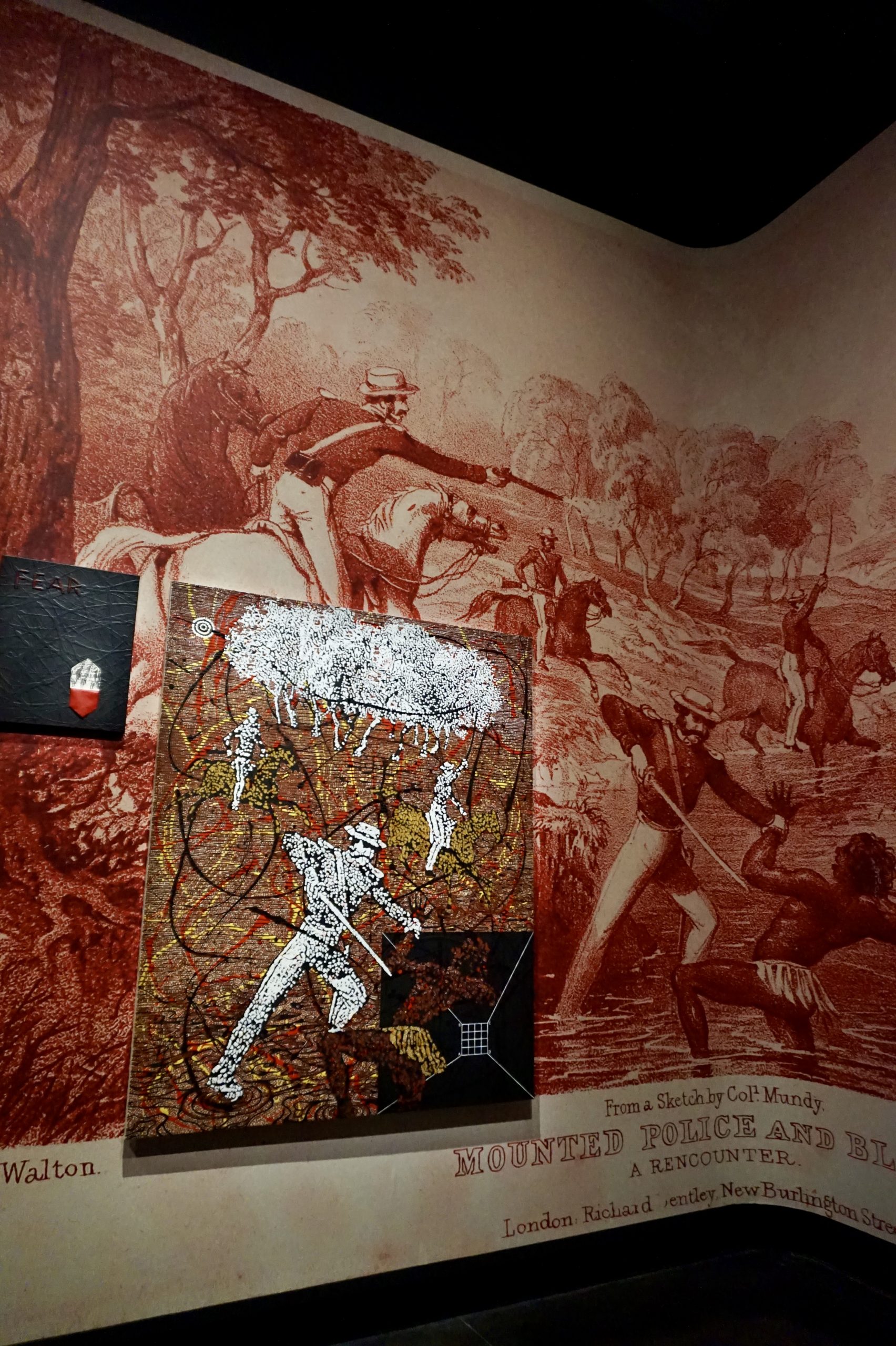
Gordon Bennett, Death of the Ahistorical Subject (Up Rode the Troopers ABC), 1993. Shown in Figures 3A and 3B.
Behind this project are three major figures in the Australian museum sphere: Professor Marcia Langton, one of the country’s most influential Aboriginal intellectuals; Judith Ryan, emeritus curator whose tenure at the National Gallery of Victoria (NGV) from 1987 to 2021 greatly contributed to repositioning Aboriginal art at the heart of the national artistic landscape; and finally Shanysa McConville, an Arrernte curator committed to research and the transmission of Aboriginal studies.
Their common thesis is to demonstrate the reductive idea of a linear Aboriginal art, frozen in a tradition fantasised by the West. The subtitle, A Short History, acts as a provocation reminding us that 65 000 years cannot be contained in a single narrative, let alone through a Western museum setting. The exhibition thus offers a thematic, chronological and geographical journey that shows art that is alive, changing and constantly reinventing itself. Specific commissions, collaborations and the strong involvement of Aboriginal communities transform the museum space into an active, inhabited and embodied space.
Colonisation, survival and resilience: a ground floor in tension
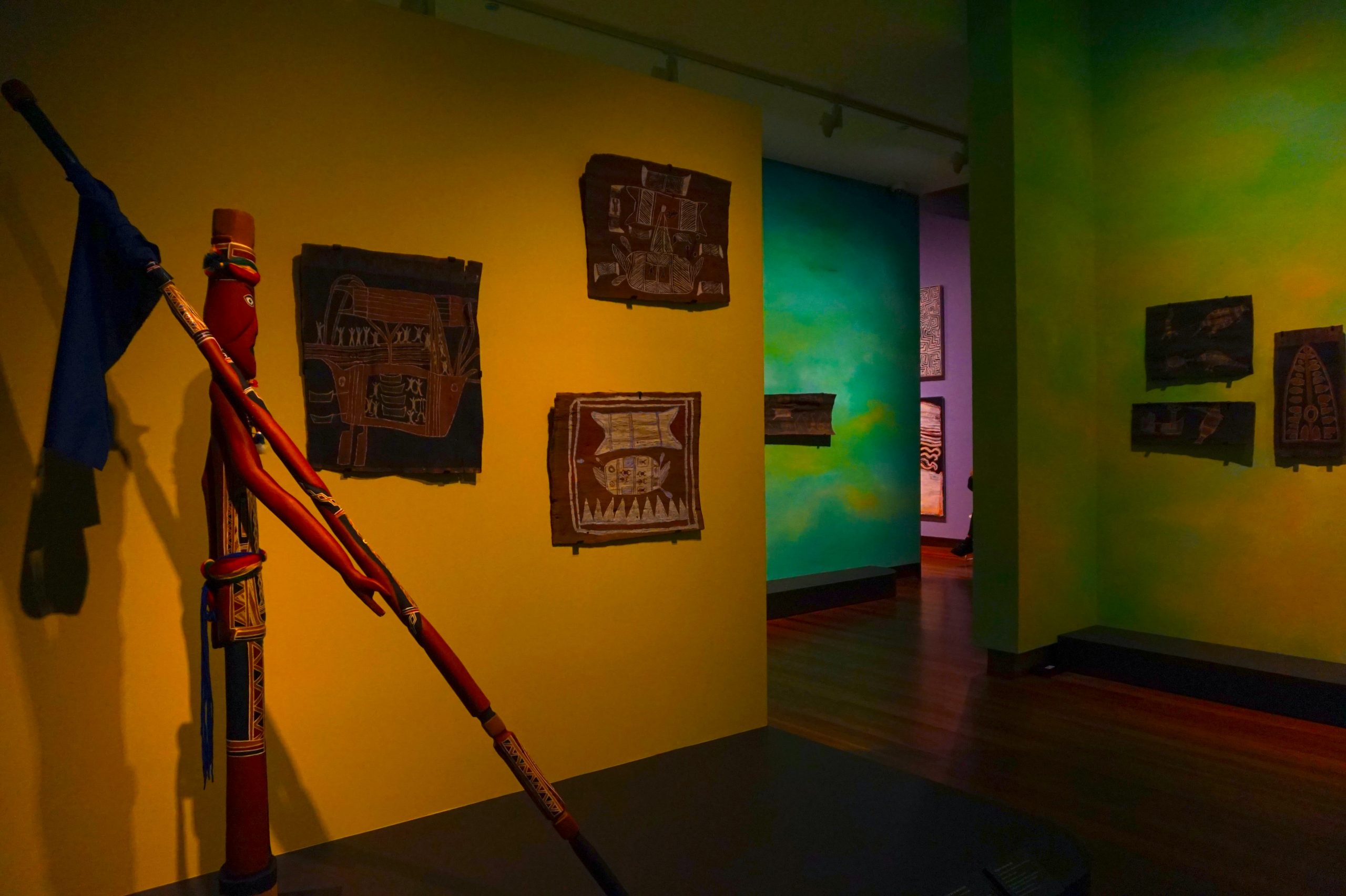
Exhibition view of 65,000 Years: A Short History of Australian Art, Potter Museum of Art, The University of Melbourne, 2025.
The first level tackles the impact of British colonialism head-on. Displayed are artworks by Gordon Bennet as well as William Barak, two artists separated by a century. Nonetheless, they are united by similar questions surrounding identity, dispossession and cultural survival. Here, the black walls are not an aesthetic choice but an immersive device. They materialise the lingering shadow of colonial violence and place the visitor in an active role: heir, witness, actor and as a responsible party.
The works presented in the open space invite visitors to move through a narrative from which there is no escape. This first chapter marks a “before and after”, reminding us that settler colonialism has irreversibly transformed the lives of Aboriginal communities, but that art has resisted and has been passed on, carrying memories.
Bright floors as an affirmation of cultural continuity
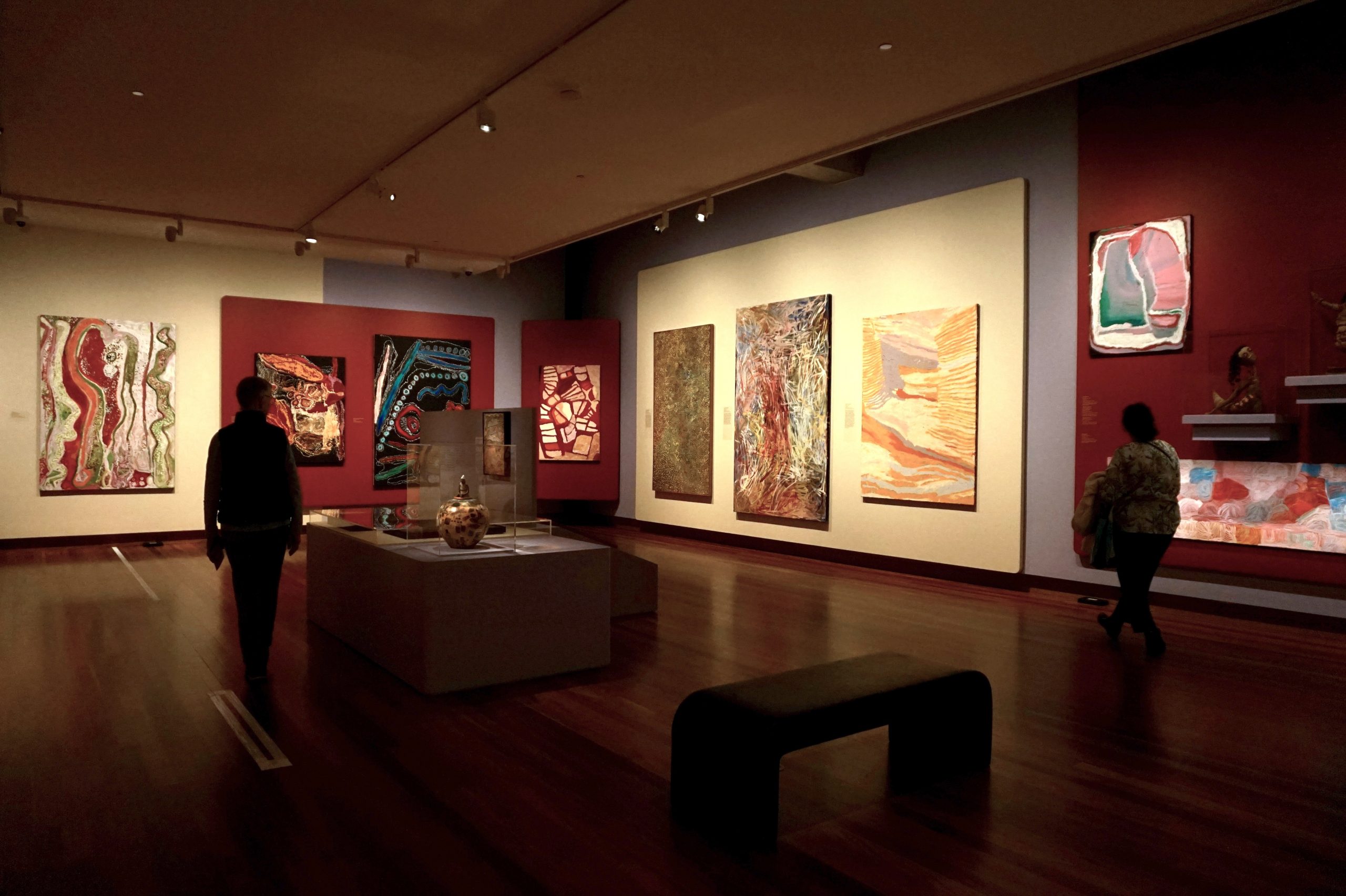
View of the Art of Central and Western Desert Gallery, from 65,000 Years: A Short History of Australian Art, Potter Museum of Art, The University of Melbourne, 2025.
Upstairs, the scenography opens up and colour dominates. Bark paintings, works from the Papunya movement, watercolours by Albert Namatjira: a vibrant panorama of Aboriginal artistic practices which, far from being static, testify to an immense aesthetic diversity. Blue, a colour rarely seen in traditions prior to the use of acrylic pigments, makes a strong comeback in several contemporary works, overturning Western expectations of what “Aboriginal art” should look like.
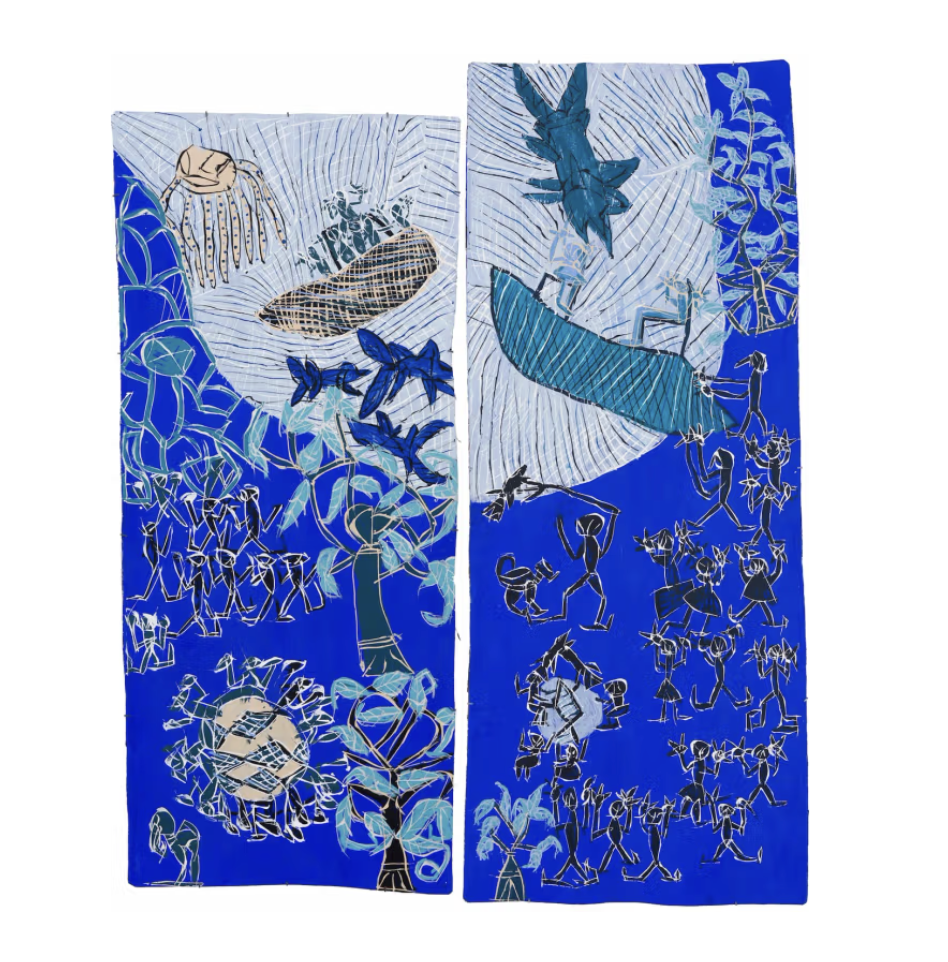
Dhambit Munungurr, Welcoming the Refugees / Scott Morrison and the Treasurer, 2021. Earth pigments and acrylic on bark; two panels, 241 × 108 cm and 260 × 102 cm. © Photo courtesy Potter Museum
Among the most relevant pieces, Dhambit Munungurr’s Welcoming the refugees / Scott Morrison and the treasurer, (2020-21) stands out as much for its visual power as for its personal history. The daughter of two Testra Art Award winners, forced to paint with her left hand since an accident in 2007, Munungurr uses blue as a language of identity and politics. It is a colour that has become a symbol of boldness, healing and modernity. A colour that perfectly encapsulates the message of the exhibition: Aboriginal art is not a relic, but a contemporary, critical and innovative force.
The hidden room: The University of Melbourne confronts its eugenics legacy
The most disturbing, and perhaps the most courageous part of the exhibition might be the room dedicated to the eugenics past of the university. Accessible through a separate door accompanied by a trigger warning, it displays the archives of Professor Richard J. A. Berry, whose pseudo-scientific work contributed to 20th-century racial theories. In 2003, Aboriginal human remains were found near his former laboratory, which operated as a brutal reminder of scientific and medical violence, as well as institutional dehumanisation.
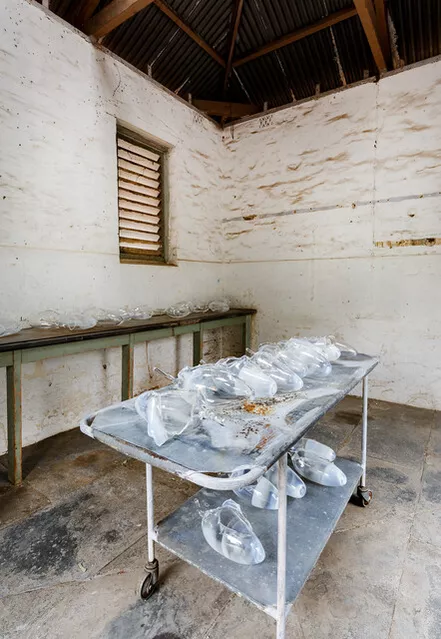
Installation view: Yhonnie Scarce, In the Dead House, Mortuary Trolley (2021). © Image sourced from This is no fantasy
In the narrow space, Yhonnie Scarce’s installation In the Dead House is both fascinating and blood-curdling. Glass bush bananas, opened like incised flesh, rest on a mortuary trolley. A powerful metaphor for bodies examined, cut up and classified, lives reduced to objects of study.
The museum as a place of truth, healing and future
This room, steeped in history, serves as the pivot for the entire exhibition. It reminds us that colonisation is not a thing of the past, but a system whose aftermath can still be seen in institutions, policies and the collective imagination. But it also reminds us that acknowledging this violence is essential to reconstruction.
Maria Langton describes the exhibition as “truthful and iconic”: truthful because it refuses to deny the past; ironic because it shows how the institutions that contributed to the marginalization of Aboriginal people are now the ones exhibiting their art.
65 000 Years is thus presented as both a museum of civilisation and a promise: that of a possible reconciliation based on truth and mutual respect. The exhibition invites us to rethink our view of Aboriginal art, no longer as an artefact, an object of ethnography or a product of Western fascination but as a major, contemporary and essential art form.
As Walpiri artist Paddy Carroll said:
“ We have had to learn your language: now it’s time for you to learn ours.”
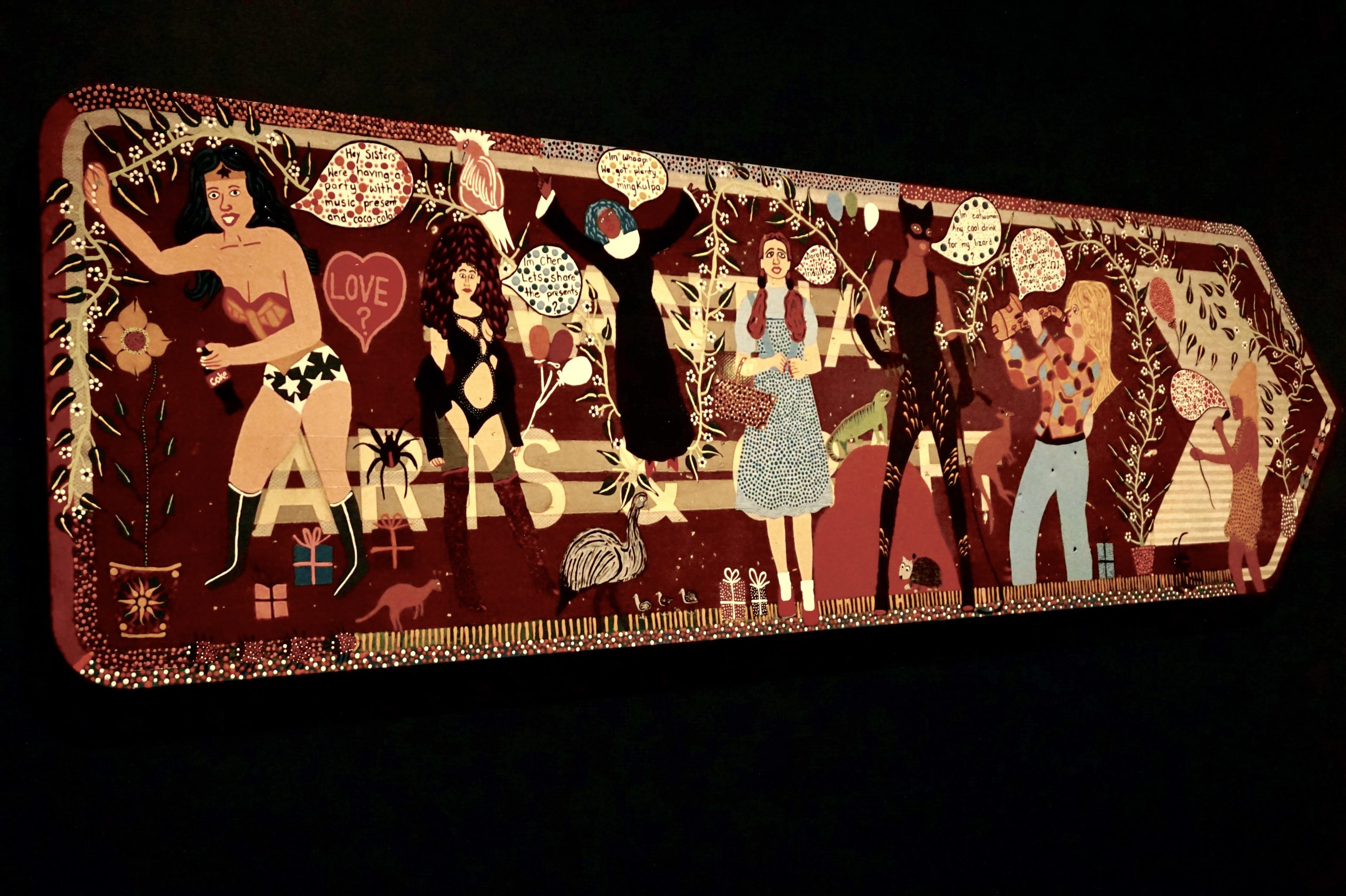
Kaylene Whiskey, Seven Sistas Story, 2021. Museum and Art Gallery of the Northern Territory. Exhibited in 65,000 Years: A Short History of Australian Art, Potter Museum of Art, The University of Melbourne, 2025.
About the author:
Pauline Colombani is a communication assistant intern for IDAIA and a student at Sciences Po Paris, currently on exchange at the University of Melbourne.
Artworks © The Artists – Photos courtesy Pauline Colombani, unless marked otherwise